
Homeowners' pick for heating and cooling across Virginia and the Mid-Atlantic
What Belongs Around the Outdoor Unit, and What Doesn't
You walk past the outdoor unit every day and never think about it. Then the mulch pile creeps up, the azalea fills in, and one August afternoon the house stops cooling. Most of what goes wrong out there is slow and preventable. Here is what belongs around that unit, what does not, and when to call us for air conditioning repair.
Call (888) 365-6280- A real person answers
- Open 7 days
- Written quote before work starts
Taking calls until 5:00 PM ET
Written by the James River Heating & Air service team and checked by our field technicians
What Crowding the Unit Actually Does
The outdoor unit dumps heat from your house into the air around it. If shrubs, fence panels, stacked firewood or a deck skirt block that airflow, the heat has nowhere to go and gets pulled straight back through the coil. The system runs longer, head pressure climbs, and the compressor works against itself. Over a few seasons that shows up as short cycling, weak cooling on the hottest days, and eventually a failed compressor or a refrigerant leak at a stressed joint. None of it happens overnight, which is exactly why it sneaks up on people. The unit still runs, just worse every year.
The Clearance That Keeps It Breathing
Give the unit roughly two feet of open space on every side and about five feet of clear air above it. Nothing overhanging, no lattice screen tight against the cabinet, no trash cans or hose reels leaned on the fins. If you want to hide it, use a screen that stands well off the unit and has real gaps, not solid boards. Watch the ground too. Mulch and soil creep up against the base over time and hold moisture against the pan and the electrical whip. Gravel or a level pad drains better and keeps the bottom of the cabinet out of standing water.
The Habit That Prevents Most of It
Walk out and look at the unit once a month during cooling season, and once more before you switch to heat. It takes a minute. Pull leaves, grass clippings, cottonwood fluff and pollen mats off the coil faces by hand. Cut anything growing within two feet back hard, and remember shrubs put on most of their growth in spring while you are not thinking about the AC. After storms, check for branches, shingle grit and mulch washed against the base. In damp shoulder seasons across the region, keep an eye out for moss and standing water at the pad, and never blast the fins with a pressure washer.
Warning Signs It Is Already Too Late
Air coming off the top of the unit that feels cool rather than hot means the coil is not shedding heat. Other signs: the outdoor fan runs but the house never catches up on a hot afternoon, the unit cycles on and off in short bursts, you hear a hard hum then a click at startup, or you see ice on the copper lines. Bent or matted fins across a whole face, rust streaking down the cabinet, and a sunken pad that has the unit leaning are all worth a look. At that point it is an air conditioner repair call, not a yard chore.
What We Check When We Come Out
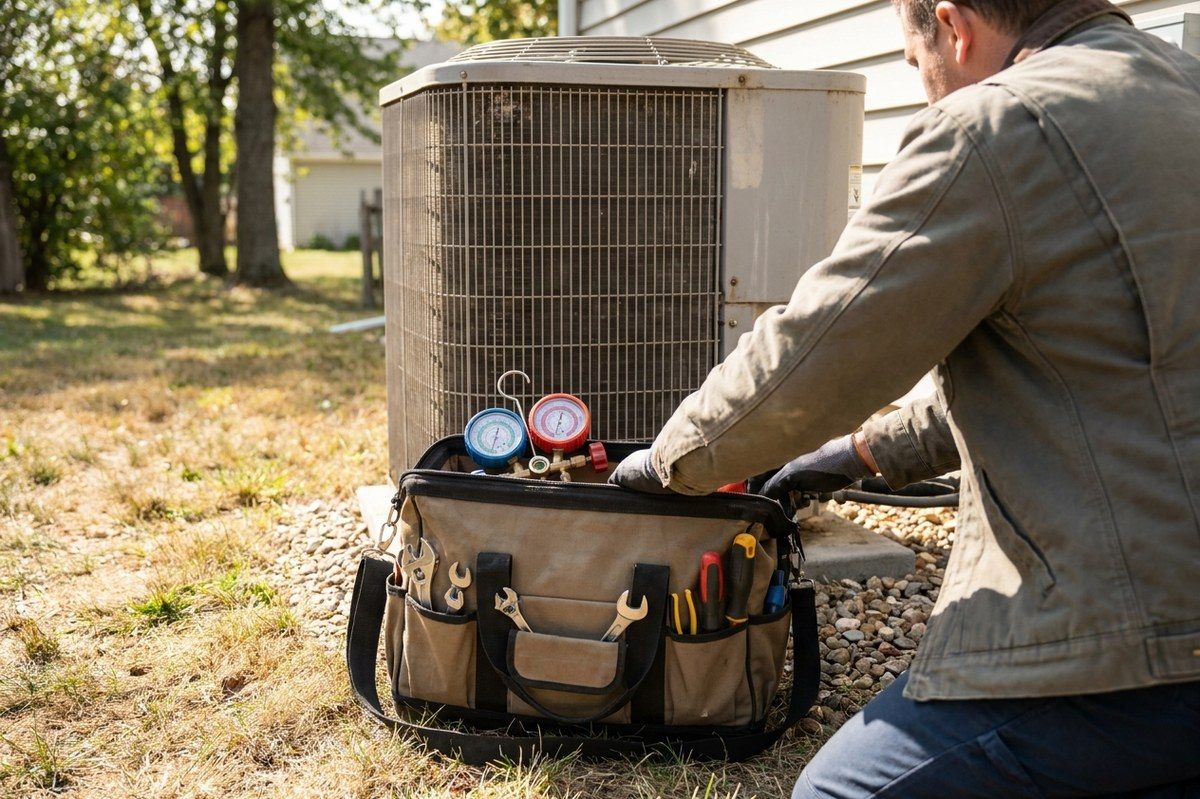
We start outside because that is where the evidence is. We clean the coil properly, straighten fins where we can, check the pad and level, and inspect the electrical whip and disconnect for water damage or corrosion. Then we read pressures and temperatures to see how much damage the crowding has done and whether the compressor is still healthy. If a leak opened up under the strain, we find it and talk through options honestly. We work on homes across Virginia, Maryland, Delaware, Pennsylvania, New Jersey, North Carolina, West Virginia and Washington DC, including older houses with ducts in vented crawlspaces where humidity makes every airflow problem worse.
What Belongs Around the Outdoor Unit, and What Doesn't — straight answers
Can I build a fence or screen around my outdoor unit?
Yes, if it stands at least two feet off the cabinet on every side, has open gaps rather than solid boards, and nothing overhangs the top. Solid enclosures trap hot air and make the system work harder every cycle.
Should I cover the unit in winter?
A full wrap traps moisture and invites rodents into the cabinet. If you want protection from falling debris, use a breathable top cover only, and remove it before you run the system again in spring.
How do I clean the coil without damaging it?
Pull loose leaves and grass off by hand with the power off at the disconnect, and rinse gently with a garden hose from the inside out if you can reach. Never use a pressure washer. Deeper cleaning is our job.
How it works
- Step 1
Tell us the symptom
Call or fill in the form and describe what changed. Warm air, short cycling, a smell, water near the indoor unit. Details like that help us load the right parts before we leave.
- Step 2
We diagnose the whole system
We check the thermostat, the indoor unit, the outdoor unit and the ductwork, including runs in crawlspaces where damp air and loose joints quietly cause weak airflow and long run times.
- Step 3
You approve the fix
We explain what failed, what it takes to repair it, and what we would watch next season. Nothing gets replaced without your yes, and we clean up before we leave.
- A real person answers
- Open 7 days
- Written quote before work starts
Why homeowners call us
- Humidity is our home groundMuggy summers and damp shoulder seasons drive most of the calls we take. We look at moisture and airflow together, not the cooling number alone, because a clammy house often means a sizing or duct problem.
- Crawlspace ducts get checkedOlder homes across the region run supply ducts through vented crawlspaces. Crushed flex, disconnected boots and soaked insulation show up constantly, and we get under the house to look instead of guessing from the register.
- Heating and cooling bothSame crew for air conditioning repair in July and heating repair in January. We know how your furnace, heat pump and air handler share ducts and a blower, so one visit covers the whole system.
- Plain talk on repair or replaceWhen a repair makes sense, we repair it. When a system is failing in ways that will keep costing you, we say so and explain why, then leave the decision with you and your timeline.
- All major brands, gas & electricCarrier, Trane, Lennox, Goodman, Rheem, York and more, as an independent company.
- Straight answersIf a system is not worth repairing, we say so, often right on the phone.
About this guide
Safe checks done and it still misbehaves? That's a real fault
Mention which checks you ran when you book; it speeds up the visit.
- A real person answers
- Open 7 days
- Written quotes
- All major brands
- Gas & electric
Rather not call? Get a free quote →